

For Buyers
This guide is designed to help buyers understand the differences between co-ops and condos and navigate the process of purchasing an apartment in New York City. From financial requirements and board approvals to closing costs and ownership considerations, The Semino Team provides expert market knowledge, personalized guidance, and skilled negotiation to help you make informed decisions and find the right property for your goals.
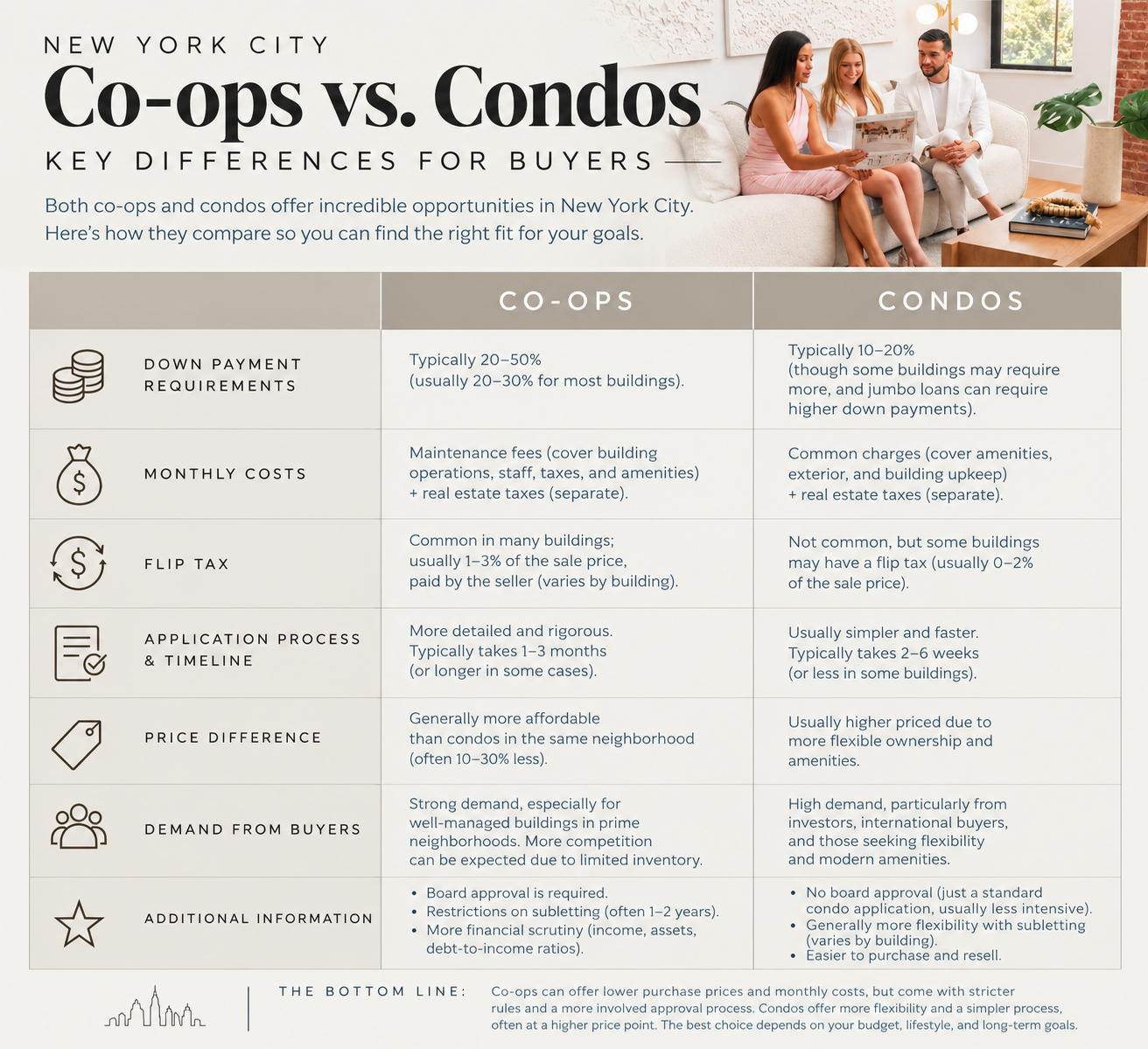

Whether you’re buying a multifamily property, co-op, townhouse, condo, or new development, The Semino Team is here to guide you through the New York City real estate market with expert advice, personalized service, and strategic negotiation every step of the way.
Linette Semino is a seasoned NYC co-op expert with a proven ability to navigate even the most challenging co-op board approval processes. With extensive market knowledge, strategic preparation, and skilled negotiation, Linette helps buyers confidently navigate complex requirements and move closer to owning their dream apartment in New York City.
This guide is designed to help buyers understand the differences between co-ops and condos and navigate the process of purchasing an apartment in New York City. From financial requirements and board approvals to closing costs and ownership considerations, The Semino Team provides expert market knowledge, personalized guidance, and skilled negotiation to help you make informed decisions and find the right property for your goals.
There Are More Co-ops Than Condos in NYC
New York City has significantly more co-ops than condos, with estimates suggesting that co-ops outnumber condos by roughly two to one. Much of this difference dates back to the co-op conversion boom of the 1980s, when many rental apartment buildings were converted into cooperative ownership.
Despite the greater number of co-ops overall, buyers can find both co-ops and condos across New York City. The key difference is understanding how each ownership type works, including its financial requirements, approval process, and flexibility.
What is a Co-op?
Co-ops are a distinctive part of the NYC real estate landscape. When you purchase a co-op, you’re not buying real property in the traditional sense. Instead, you are buying shares in a cooperative corporation that owns the building. The number of shares you own is based on the size of your unit. Along with your purchase, you’ll receive a proprietary lease, which outlines your relationship with the co-op and your rights as a shareholder.
What is a Condo?
In contrast, a condo is true real estate. When you buy a condominium, you own the individual unit itself, along with a shared interest in the building’s common areas such as hallways, elevators, and other shared spaces. With a condo, you’ll receive a deed, which serves as the official record of ownership for your unit.
Down Payment Requirements:
Co-ops vs. Condos each building has its own specific requirements, but in general, co-ops tend to have stricter down payment rules. It’s common for co-ops to require a minimum down payment of 20%, and some may demand as much as 50%. These higher down payments often ensure that purchasers have substantial financial reserves. In rare cases, certain buildings may not allow any financing at all.
Condos, on the other hand, usually require a 10-20% down payment, though this is more of a guideline than a strict rule. In some cases, you might find a condo building that accepts a 10% down payment. In both co-op and condo purchases, your debt-to-income (DTI) ratio is an important factor. This ratio is calculated by dividing your monthly debt payments by your monthly gross income. Many co-op boards have strict limits on DTI, often setting the cap around 28%. Be sure to factor this into your financial planning when considering a purchase.
Approval Process:
Co-ops vs. Condos Once you’ve found the perfect apartment and worked out your finances, the approval process will be your next step. For co-ops, however, this process can be more complex and time-consuming. Co-ops typically require buyer approval from their board, which includes submitting an application and undergoing a personal interview. The board has the authority to reject a buyer for almost any reason, making this process notoriously difficult and often lengthy.
In comparison, the approval process for condos is much simpler. While the condo board has the right to purchase the unit from the seller at the same price, this is rarely exercised. In most cases, the condo board will waive this right and approve your purchase without the need for an interview or extended review process.
What About Subletting Policies?
Most co-ops have strict rules around subletting, including minimum time periods that an owner must live in an apartment before they can rent it out. And some co-ops don’t allow subletting. When subletting is permitted, co-ops usually have limits on how long an owner can rent out their apartment within a five-year time frame. With a condo, you can rent it right away which the reason investors prefer condos.
What Are Closing Costs?
Closing costs are additional taxes and fees that both buyers and sellers have to pay when closing on a home sale. A good rule of thumb for buyers is to be prepared to spend 2-5% of the purchase price in closing costs, and expect the percentage to be on the higher end for condos, townhouses, homes over $1 million, and new developments.
Do Condos Have Higher Closing Costs?
If you’re purchasing a condo, you should expect higher closing costs. Since a co-op is considered shares of a building and a condo is real estate, there are several additional fees to consider, including title insurance and mortgage taxes.
Both condo and co-op buyers will have to pay attorney fees, and a mansion tax if the apartment is purchased for over one million dollars. A good rule of thumb is to be prepared to spend 2-5% of the purchase price on closing costs, with condo buyers usually approaching the higher end of that range.
Are You Purchasing a New Development in NYC?
Buyers often face significantly higher closing costs compared to buying an existing apartment. NYC real estate transactions come with a variety of costs, including attorney fees, mansion tax, mortgage recording tax, transfer taxes, and title insurance. What many buyers don’t realize is that there are additional costs that can be negotiated. If the sponsor isn’t willing to negotiate, your closing costs could easily exceed 5% of the purchase price, especially if you’re taking out a mortgage. These costs are largely made up of transfer taxes, plus seller attorney fees, which can add $3,000 or more. For example, when buying a $2,000,000 apartment in a new development, you should budget around $110,000 for closing costs. Here’s a breakdown of the New York Real Property Transfer Taxes:
For properties under $500,000: 1% of the purchase price goes to NYC
For properties over $500,000: 1.425% of the purchase price goes to NYC
All properties: An additional 0.40% of the purchase price goes to New York State
What is a Flip Tax and Who Pays It?
The average co-op apartment flip tax in NYC is 1% to 3% of the sale price, and it’s customarily paid by the seller. The flip tax varies by building, and in rare instances you may even encounter a condo which charges a flip tax in New York City. A flip tax in NYC can be structured as a percentage of the sale price, a flat fee, a per-share amount or some combination of the methods above.
What Is a Capital Contribution Fee in NYC Real Estate?
If you've been looking at condos or considering a new development, you've likely come across a capital contribution fee listed as part of your buyer closing costs. Many condos and new developments charge buyers this fee, which is typically equivalent to a few months' worth of the apartment's common charges. In some cases, a new development may charge two separate capital contribution fees.
The first fee is the traditional one, usually covering a few months of your apartment's common charges. This fee helps the building establish or build up its capital reserve fund. The second fee may be a per-unit charge, often used to help fund the cost of the live-in superintendent's apartment.
Why Do Boards Assess Apartment Owners?
Generally, assessments are used to fund capital improvements in a building. Capital improvements can be anything from renovating the lobby to installing a new furnace system to a facade restoration. Buildings will often have financial reserves available to handle small improvements or expected maintenance. However, for bigger-ticket items, the condo or co-op board may decide to assess owners to raise money for these improvements.
What Is the NYC Mansion Tax?
You’ve found the apartment. You’ve calculated the down payment, estimated the mortgage, and budgeted for closing costs. Then your attorney mentions two words you may not have planned for: mansion tax.
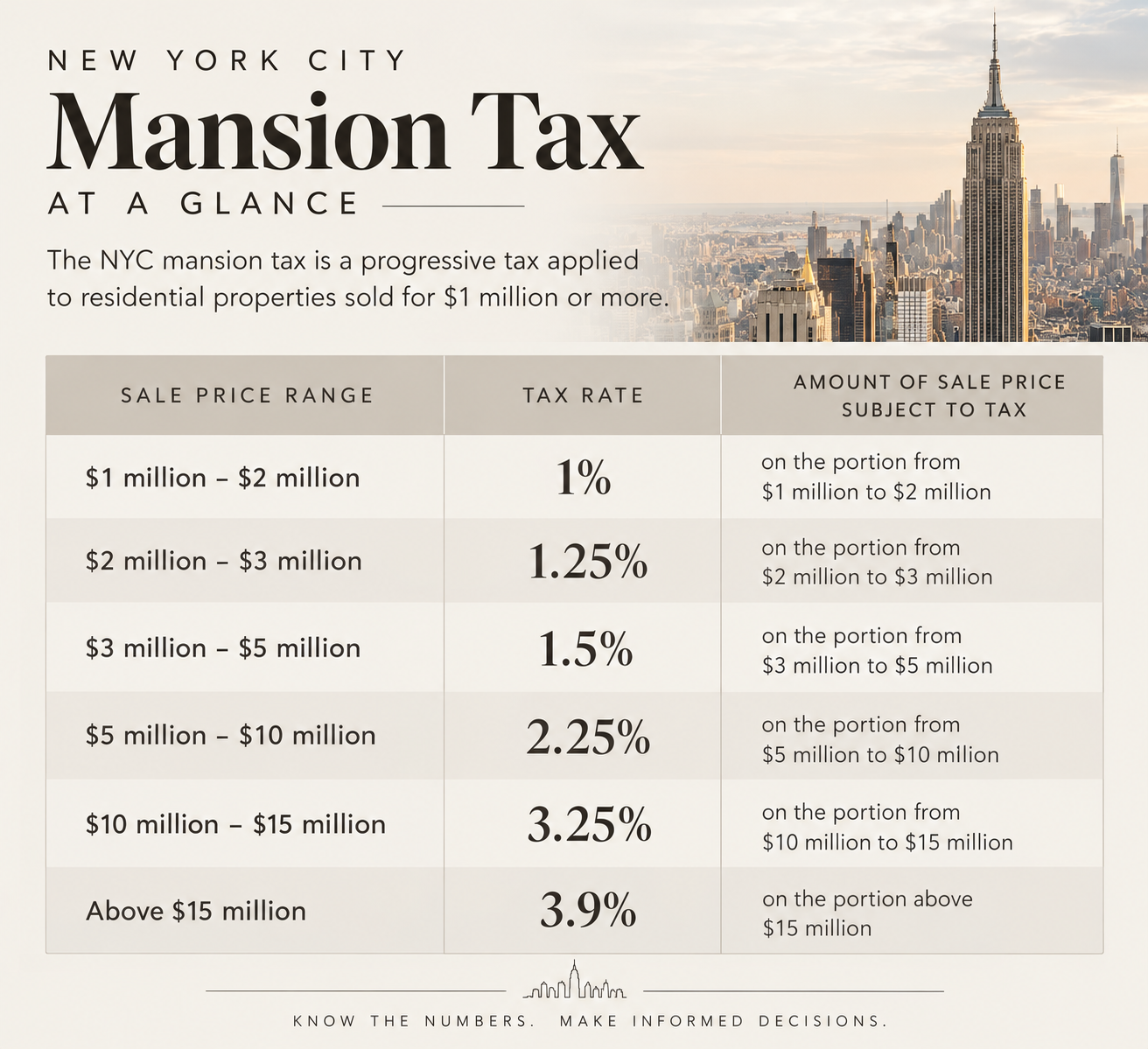
The mansion tax is a one-time New York State transfer tax imposed on residential property purchases in New York City with a sale price of $1 million or more. It is paid by the buyer at closing, in addition to other closing costs.
Despite the name, you don’t need to be buying a mansion to pay it. In New York City, $1 million might buy you a perfectly ordinary two-bedroom apartment in many Brooklyn neighborhoods. No ballroom or private elevator required!
Introduced in 1989, the tax originally applied at a flat rate of 1% to qualifying sales of $1 million or more. In 2019, New York State introduced additional tax brackets for New York City properties, increasing the rates progressively based on the purchase price. Today, the rate ranges from 1% to 3.9% for the highest-priced properties.
Why does this matter? If you’re buying in NYC, the mansion tax can add thousands—or even hundreds of thousands—of dollars to your closing costs. Understanding how it works before you make an offer can help you budget accurately and avoid surprises at the closing table.